
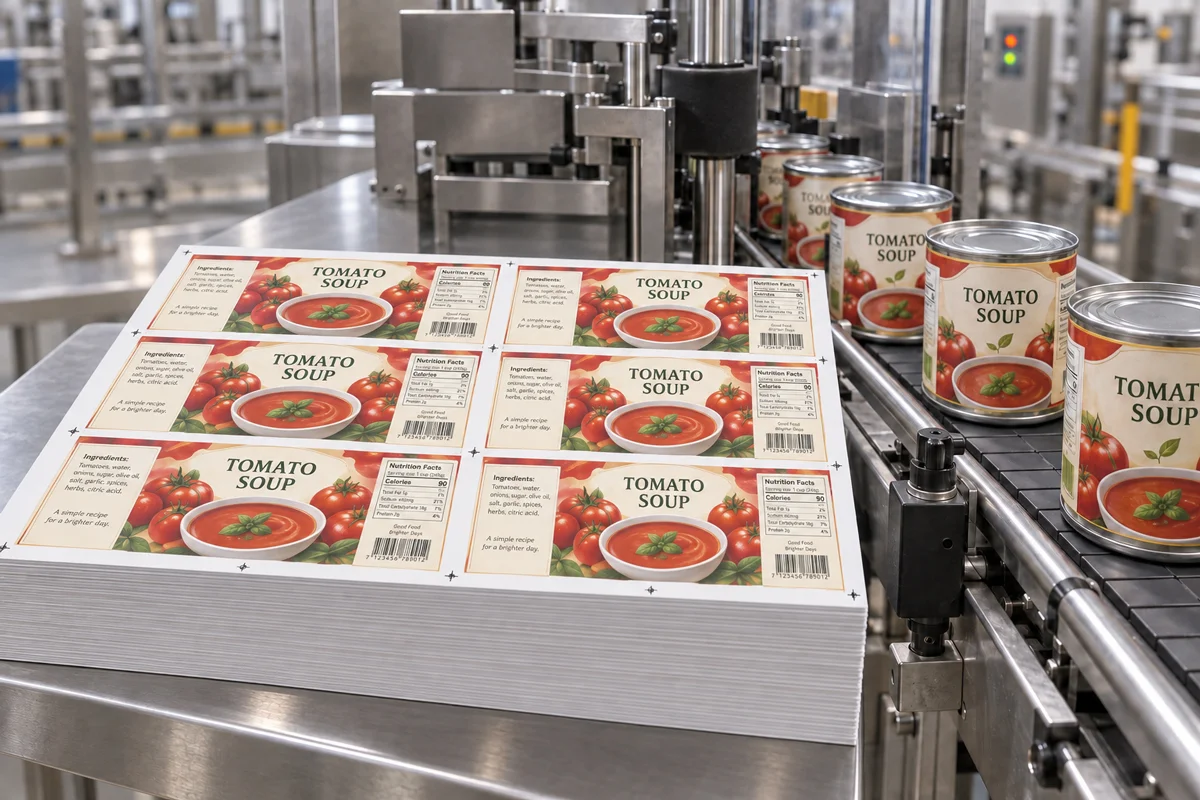
Cut & Stack Labels: Engineered for Your Labeling Line
By Al the Label Guy
Beans, tomatoes, soups, sauces. Canned foods may look pretty straightforward sitting neatly on a grocery shelf. Getting thousands, or millions, of those cans labeled and ready for that shelf is another story.
For high-volume canned food production, a successful label starts with something customers rarely see: the labeling equipment.
That’s especially important with Cut & Stack labels. Before talking about paper, graphics, or print quantities, a label supplier needs to understand the equipment at your facility or co-packer. After all, a great-looking label isn’t much help if it doesn’t run properly on the line.
What Are Cut & Stack Labels?
Cut & Stack labels are printed on large sheets, cut into individual labels, and delivered in stacks. Unlike labels that arrive with adhesive already on them, Cut & Stack labels receive their glue during the application process.
As containers move through the production line, compatible labeling equipment applies adhesive to the label (or container) and applies it to the container. This process is well suited to high-volume production of consistently sized cylindrical containers, which is one reason Cut & Stack labels are so familiar in the canned food aisle.
They’re commonly used for canned fruits, vegetables, soups, beans, sauces, pet foods, and other products produced in large quantities.
Your Equipment Comes First
When Gamse talks with a customer about a Cut & Stack project, one of the first questions is about the labeling line.
Does your facility have equipment designed to apply Cut & Stack labels? If you’re working with a co-packer, what equipment are they running?
Those answers help establish the specifications for the label itself. Container dimensions and application speed matter. So do details such as label overlap and how the equipment applies the glue.
In other words, the label needs to be engineered for your labeling line, not simply designed for your container.
Think Beyond the Production Line
The job isn’t finished once the label is on the can. You also need to think about what happens to the product afterward.
Consider the conditions the label will encounter throughout its life cycle. How hot is the product when it’s filled? Will the cans encounter moisture during production? How will they’re stored and shipped? What kind of handling can they expect before they reach the shelf?
Those practical details can influence the paper, coatings, inks, and other specifications chosen for the job.
Packaging specifications vary wildly between climate-controlled dry warehouses, moisture-heavy breweries, and high-stress production or distribution environments.
High Volume Still Has to Look Good
Cut & Stack labels are built for efficiency, but efficiency doesn’t mean your packaging has to look ordinary.
Gamse handles large-volume label programs ranging from thousands of labels into the millions. With custom die capabilities, expanded gamut printing, different label materials and other options, brands can create labels that work reliably on the line while still delivering the color and shelf presence they expect.
We’ve been printing labels since 1896, so we’ve learned that the best label projects usually start with questions, not presses.
Tell us about your containers, your equipment, and where your products are headed. We’ll help you find a Cut & Stack label solution engineered for your labeling line. Get started with Gamse today.